Accessibility

Welcome to Wakefield

Market Position Statement, or MPS, is a document used by local authorities to facilitate development and growth within their care markets. The MPS provides an overview of the current care market, the most statistically probable demand forecast for the period that the MPS covers, then the actions that need to be taken to ensure people are able to receive the care and support they need.

The MPS is mostly aimed towards the following people:

  • people who buy social care services which includes local authorities, integrated care boards (representing GPs and hospital trusts), personal budget holders and people who meet all or some of their own costs, commonly referred to as self-funders.
  • providers of social care services, including those regulated by the Care Quality Commission (CQC), such as residential and nursing care providers, homecare providers, supported living services and extra care.
  • wider services which support well-being of local populations including community and voluntary services, micro and social enterprises, personal assistants, housing, leisure, transport, and information and advice services.
  • a range of potential investors in the social care market from corporate investors through to charitable or philanthropic donations.
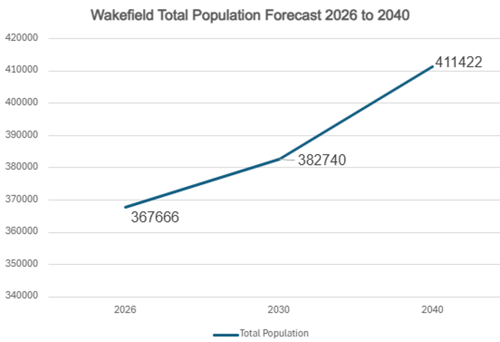
Wakefield District spans 339 square kilometres and is home to 367,666* people, across a rich mix of city, town, and rural communities. It boasts a historic city, proud towns, vibrant villages, and beautiful countryside, making it one of the most well-connected areas in West Yorkshire.

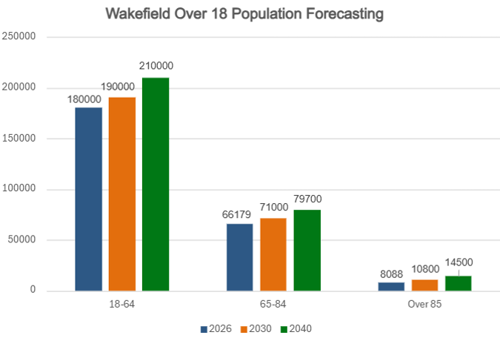
The population is predicted to grow by 4.0% in the next 5 years, with a population projection of 387,428 by 2031. There is a continued trend towards an aging population across the district. People aged 65+ will account for 20.9% of the total population by 2031.*
With healthy life, or years living in good health, expectancies of 55.8 years for women and 55.7 years for men*, comparing to the full life expectancy of 81.4 years for women and 77.5 years for men**. Meaning that people could live with ill health, potentially in need of care and support, for up to 25.6 years for women and 21.8 years for men.

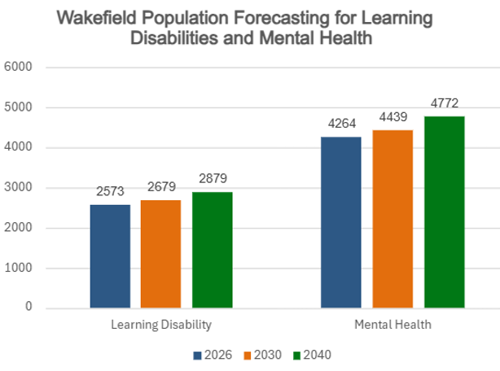
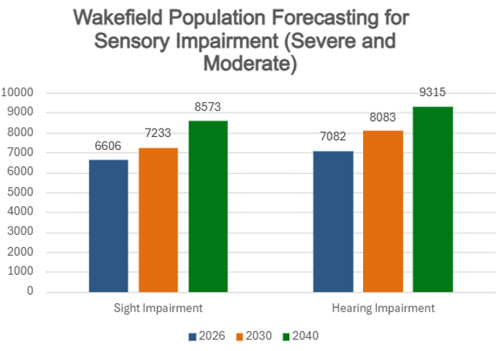
With the expected population growth of 4% across the district, we also expect to see an increase in those needing support. Currently, of the total population, 0.7% of people live with a learning disability and 1.16% with a severe and enduring mental illness. Should these statistics continue, we will see an increase in people needing support with Learning Disabilities and Mental Health by approximately 11% between now and 2040. For people with sensory impairments, the population affected by severe or moderate impairments, is due to increase 23% for sight and 24% for hearing by 2040.

Further demographics data for Wakefield can be found at Demographics – Wakefield JSNA.

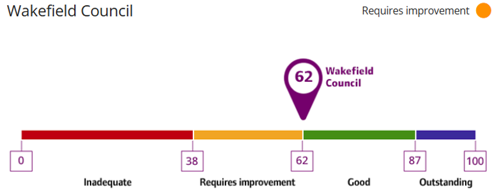
Wakefield Council was inspected by CQC in April 2025, the resulting score was requires improvement. 

Within the two areas which focus on the Council’s relationship with the care market in the district, in both categories the results were ‘Good’.

The outcome of this rating was as a result of there being evidence of:

  • Good strategic awareness of population need, including inequalities, with links into Public Health
  • Strong commissioning foundations, with a clear shift towards community-based care and promoting independence
  • Mature partnership working, particularly with the Integrated Care Board and Housing colleagues
  • Active market oversight and sustainability planning

To see more information on our inspection report, please see:  Wakefield Council: local authority assessment - Care Quality Commission

2023-25 Market Position Statement

2026-30 Market Position Statement

Unless stated otherwise, the below information is from the 2022/23 financial year:

We provided 906 short term services to maximise people’s independence.
5,616 adults received long term care and support, either in the community or in residential or nursing settings.
64% of adults receiving long term care were supported in the community, 36% were in residential or nursing care setting.
490 aged 65 and over were permanently moved into residential care with our help (including self-funders).
1,527 people aged 18-64 in receipt of long-term support with 83% supported at home.
2,781 people aged 65+ of which 60% supported to live at home.
There were 906 episodes of short-term support to maximise independence provided. 775 (85.5%) were new referrals and 131 (14.5%) from people already in receipt of a longer-term service.
The number of episodes of short-term support for new clients has decreased 11% compared to 2020 / 2021 (95 less) and 21% for existing clients (34 less).
From short-term provision, 192 people went on to receive long-term support in comparison to 260 people in 2020/2021.
Wakefield Council’s adult social care received 12,383 new requests for support: an average of 34 per day.
820 people with a concluded short-term support to maximise independence episode during 2025 (Jan-Dec).
6,205 adults aged 18+ accessed long term care and support during the year, either in the community or in residential or nursing settings. 4,695 adults aged 18+ accessing long-term care and support at period end (as at Dec-25 published data).
3,245 adults aged 18+ accessing long -term care and support for 12 months+ (as at Mar-25).
71% of adults aged 18+ receiving long term care are supported in the community, 29% in residential or nursing care setting (as at Dec-25 published data).
1,395 adults aged 18-64 accessing long-term care and support, of which 84% supported at home (as at Dec-25 published data).
1,930 adults aged 65+ accessing long term care and support, of which 64% supported to live at home (as at Dec-25 published data).
3,055 adults aged 18+ received an adult social care assessment (in the 12 months up to the end of Dec-25).
In 2024-25 470 adults aged 65+ were permanently moved into residential care with our help (including self-funders), 33 adults aged 18-64.
In 2024-25 86.8% of new adult social care clients receiving reablement, where no further request was made for ongoing support.
In 2024-25 Wakefield Council’s adult social care received 7,795 new requests for support.

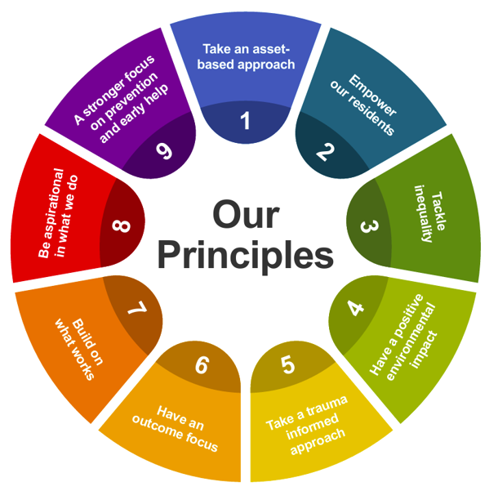
Wakefield Council are committed to ensuring our commissioned services meet the diverse needs of our local community, to deliver this we have the following priorities:

  • Map the assets commissioned by Wakefield Council, as this will allow a clear understanding of gaps in relation to service accessibility for diverse groups and demographics of people accessing services.
  • Work with our wider Council services such as Communities teams and Public Heath, and VCSE to engage with those who are under-represented within services.
  • Revising procurement and contract management processes to embed Equality, Diversity and Inclusion principles within their approach and intended outcomes.
  • Understanding why services can be ‘hard to reach’ for these communities and identifying opportunities to improve access to support and awareness of services that are available.

More information on our ethnicity demographics can be found here: Ethnicity – Wakefield JSNA

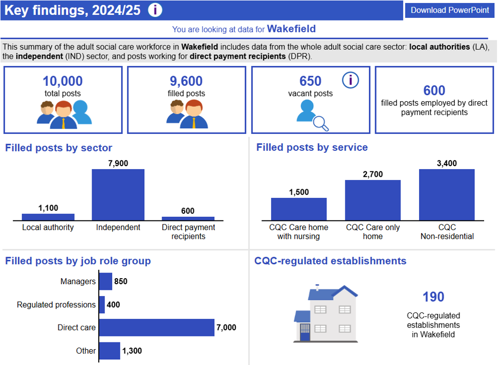
With 7,900 posts of 9,600 across Wakefield being linked to the external market, this confirms Wakefield’s high dependency on the independent sector, reinforcing the MPS position that market sustainability is critical to statutory delivery. Workforce instability in even a small number of providers presents system‑wide risk, strengthening the case for proactive engagement, fair cost of care approaches, and early market‑failure mitigation.

The data supports the MPS narrative that recruitment and retention remain structural risks, particularly in frontline roles. The limited regulated workforce raises concerns about professional oversight, safeguarding capacity, and clinical leadership, especially as complexity of need increases.

Workforce capacity must be treated as a core market‑sustainability metric, not a provider‑level issue, requiring joint action with providers, and system partners, rather than short‑term recruitment initiatives conducted in silo.

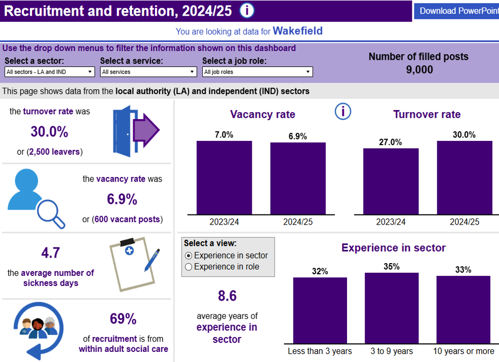
The 2024/25 recruitment and retention data highlights persistent workforce instability across Wakefield’s adult social care market, reinforcing the key risks set out in the Market Position Statement (MPS). Across the local authority and independent sectors there are around 9,000 filled posts, but this capacity is under sustained pressure from high turnover and ongoing vacancies.

The turnover rate has increased to 30%, equating to approximately 2,500 leavers in the year, up from 27% in 2023/24. This level of churn significantly undermines continuity of care, provider resilience and quality, and aligns with the MPS assessment that workforce retention is a critical threat to market sustainability. The vacancy rate remains high at 6.9% (around 600 posts), showing little improvement year on year and limiting providers’ ability to respond flexibly to demand.

Workforce health and stability indicators also reflect pressure: the average 4.7 sickness days per worker adds to short‑term capacity challenges, particularly in frontline services. Encouragingly, 69% of recruitment comes from within adult social care, suggesting some internal labour market resilience, but also highlighting the limited success of attracting new entrants into the sector, a concern already recognised in the MPS.

Skills for Care workforce dataset: My local area (Wakefield)

Last updated: 21/08/2026