Accessibility

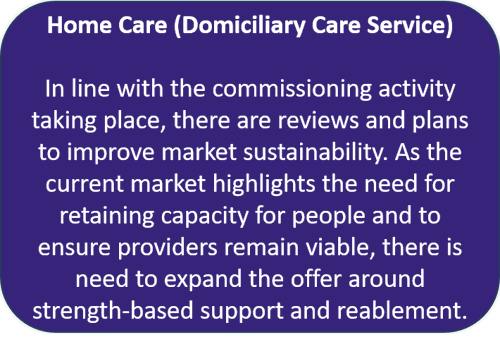
The home care market has become increasingly over-saturated following the transition from closed frameworks to open Pseudo Dynamic Purchasing Systems (PDPS). While this shift has increased capacity and choice, it has also intensified competition between providers, contributing to potential market instability and undermining long-term sustainability.


Sustainability risks are growing across the sector. Many providers are highly exposed to fluctuations in commissioned volumes and experience financial pressure when care packages are lost or reduced. This pressure, particularly for smaller and medium-sized providers, is limiting their ability to invest in workforce development, digital systems, and quality improvement.
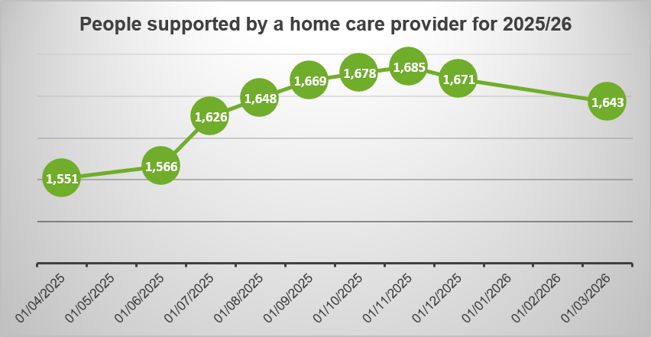
Overall quality of care is variable. Personal care delivery is generally reported as good, and most providers are meeting care expectations. However, there are persistent operational issues that directly impact people’s experience, notably late or missed calls and inefficient rota planning. These issues are often linked to workforce shortages, travel time pressures, and poor alignment between commissioned care patterns and provider capacity, and they remain a key source of complaints and quality concern.


Workforce challenges continue to constrain performance and sustainability. There is a heavy reliance on overseas recruitment to fill vacancies across a number of providers, which has helped maintain capacity but brings additional challenges. This increases cost pressures for providers and variability in practice across the market due to the need to deliver effective training, which can be time consuming when facing staff shortages.


To increase sufficiency and deliver less restrictive services within the sector. The offer from the optimised handling service will be shared through future home care contracts, increasing capacity of this type of support, by delivering improved single-handed provision, through effective training and use of equipment. 


Data quality and Electronic Call Monitoring (ECM) remain in need of improvement. There are consistent discrepancies between planned and actual hours, and care that is reported within systems. The Coordination team is regularly reviewing call monitoring returns against invoices in order to understand the impact of this.
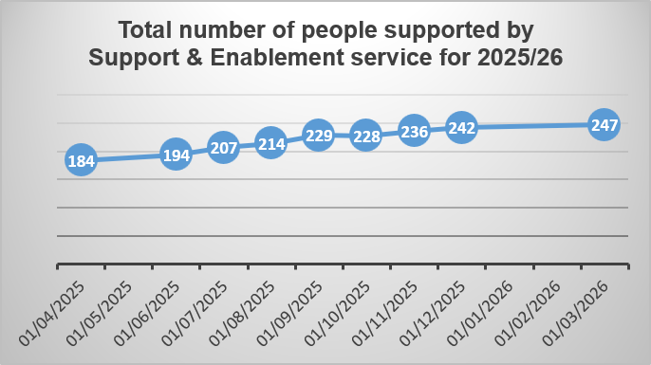
 

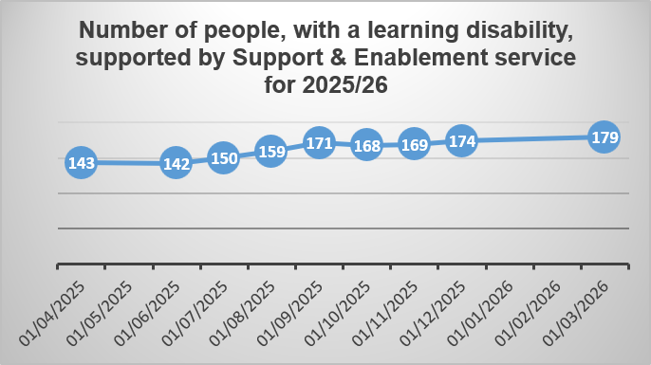
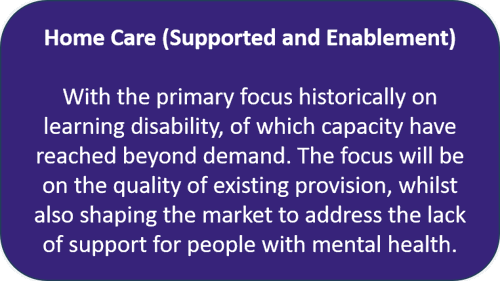
This home care for learning disabilities and mental health support is delivered through the My Life Dynamic Purchasing System, providing targeted support and enablement to help people access their local communities. Historically, the offer has focused primarily on people with a learning disability, with outreach support designed around that cohort. There is now a clear requirement to review and further develop the offer to better meet the needs of people with mental health needs, ensuring the offer reaches all people that need this type of support.


The service is designed to meet needs around community access and outcomes-based support, rather than traditional personal care. A flexible delivery model allows people to ‘bank’ their support hours over a four-week period, enabling more personalised, outcome-focused interventions aligned to people’s goals and preferences. For example, this system allows people, especially those with fluctuating care needs within mental health, the ability to tailor their weekly support in response to their current presenting needs. This offer will be explored further during our review, to maximise this offer.
It is recognised that the current service specification is due for review. There is an opportunity to introduce greater flexibility within the offer, supporting innovation in delivery and better alignment with prevention and personalisation objectives, to promote and continue people’s independence pathways.


Demand for the service has reduced, with a corresponding decrease in the waiting list for provision. This presents an opportunity to reflect on current commissioning arrangements, assess market capacity and utilisation, and consider how the service can be reshaped to respond to emerging needs particularly in relation to mental health while maintaining a good quality within the community-based outcomes for those supported by this service.


Day Opportunities across Wakefield are delivered through a variety of arrangements, including in-house, spot contracted and grant arrangements. There remains inconsistency in the offer, delivery and demand across this sector. Ranging from transitional to over 65s day opportunities, there is opportunity to develop and shape existing, potentially new, provision into a stronger offer for the whole district. 

There is a long established in-house day opportunity offer for Wakefield, and due to existing arrangements in place with the external market, there will be a review of the sector to explore how the internal and external provision can be offered at the point of need, what the offers will be how gaps in the market can be met.

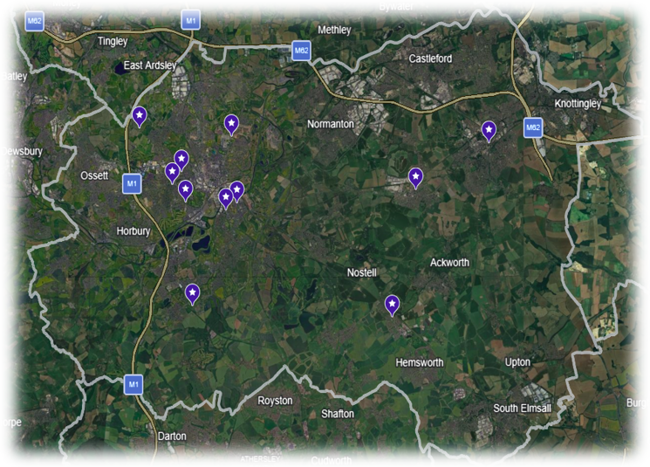
External Day Opportunities currently attended by people supported by the Council.

The standard offer operates between 9am and 3pm, which limits suitability for working families and reduces flexibility. Where in-house provision is unavailable or unsuitable, provision is then sought based on location, availability, and offer, often resulting in people attending multiple different day services concurrently to meet needs.


A range of external and spot-purchased provision is used to supplement in-house capacity, whilst these arrangements enable greater choice for some, they generate inconsistent offers and lack a clear commissioning framework within adult services, leading to inconsistencies in access, sustainability, and understanding of what can be offered from this sector. For example, there is a need to jointly develop day opportunities linked to employment pathways, as previous services within this offer have since ceased providing services. Specialist provision exists but is constrained. With some day opportunities that are valued but have limited capacity within the offer, due to complexity of need at these services, those offering this provision have very few available spaces. 


Traditional day opportunities, or previously known as day services, remain the dominant model, and practice has increasingly focused on stabilisation rather than progression, with people becoming accustomed to fixed levels of support. Where support is withdrawn, people known to the Learning Disabilities team often “bounce back” into services, highlighting ongoing vulnerability and limited resilience of the current offer.


There is a need for clearer oversight and management with a review of the balance between in-house and external provision, addressing the gaps for complex and what would require 1:1 support. With strengthen progression pathways beyond traditional day services, allowing for greater alignment between children’s and adult commissioning, alongside clearer strategic intent for specialist and employment-focused day opportunities, all will be critical to improving outcomes and sustainability.


Last updated: 21/08/2026