Accessibility

Overview of the Care Market

As of May 2026:

Over 11,000 people were accessing preventative services.
There were 13,000 registered unpaid carers.
4,830 were people receiving support through both long-term and short-term services.
The weekly cost of care packages to support people was £3.92 million.
There was 182 CQC registered providers within the Wakefield District.
Of the people supported, there were 345 people ‘out of area’ at a cost of £626,670 per week.

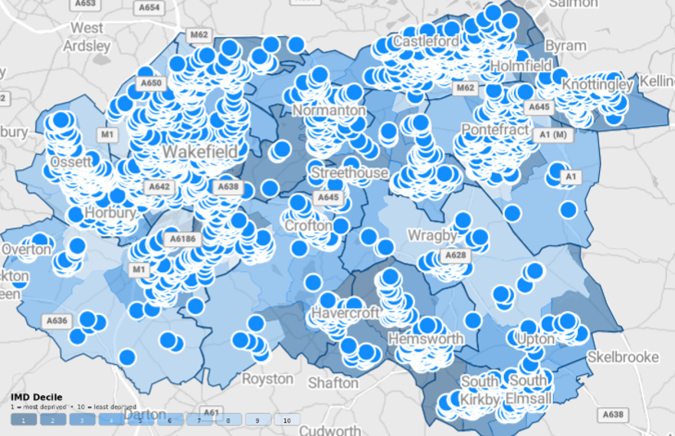
Care provision mapped against level of deprivation for ‘in district’ provision.

Provision Type
What is working well
Area for improvement
Nursing Homes

Capacity within the market for standard nursing care.

Supporting the workforce, especially registered nurses, remains important.

Residential Homes

There is a strong overall supply of residential care, with a mix of small independent homes alongside regional and national providers.

Improving messaging to clearly reflect the oversupply of general residential care in the Wakefield District and the need to develop specialist provision.

Respite

The offer provides good quality standard and emergency respite through a mixture of in-house and external services.

Demand is high than capacity, there is the need to understand that gap to better shape the development of this sector.

Supported Living

Good capacity with Learning Disability provision, with the ability to now reflect on best practice and develop the existing market to meet complexity and service for people with mental health needs.

Still a high number of requests to enter a high vacancy market from developers. Need to develop the offer around mental health provision.

Extra Care

High demand for service with a model that offers both prevention and reduction in care needs.

Need to appropriately review demand to understand potential development opportunities due to growing waiting lists for already full schemes.

Home Care

The domiciliary care service has no waiting list, with all individuals receiving timely support. Sufficient capacity with the learning disability offer, meaning no waiting lists for community engagement.

The next domiciliary care contract will focus on delivering high-quality, sustainable provision. The My Life contract needs to develop the offer to expand from learning disability and into mental health support.

Day Opportunities

Sufficient capacity to meet existing demand, with a core group setting offer across the district.

Need to understand the unmet need within this provision, potential to initially shape market through personal budgets to help understand commissioning activity potential.

Homelessness Pathway

Provision meets a wide range of need, although tested due to co-complexities of people, often can support people presenting with multiple needs.

Need to develop capacity within move on provision, including strengthening pathways into standard housing options.

Prevention (VCSE)

Scope of the services on offer to support people before the need for assessed services.

How we engage with the market on new opportunities.

Personalisation

Consistent demand in new services under Direct Payments and Individual Service funds, which can be built upon in relation to improvement priorities.

The current offer is limited, to increase referrals a clear understanding of what can be offered through budgets needs outlining.

Carers Service

Ensuring the inclusion of carer voice within market offers and shaping to what should be offered and could help them.

Awareness of how to access support and reaching seldom heard voices.

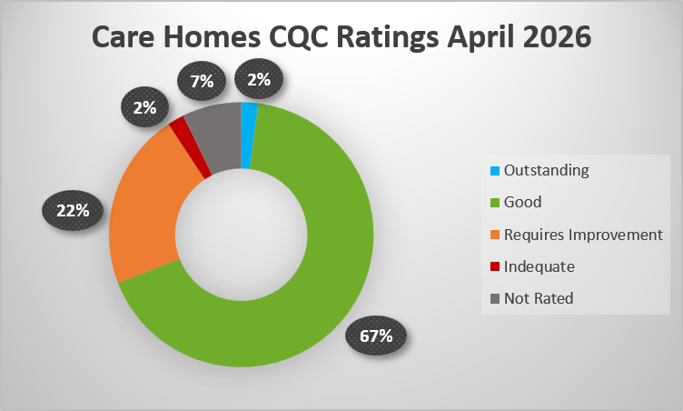
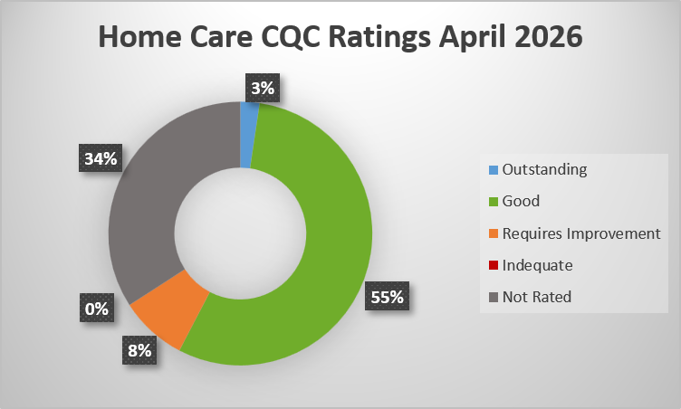
Wakefield has 182 services registered with the Care Quality Commission (CQC) across all service types to support adults, or over 18s, across the district. Of the 182 services registered 148, or 81%, have been inspected an received a rating. We closely monitor care homes, both nursing and residential, and home care ratings, with the aim to expand local reporting into wider CQC regulated provision types, such as supported living. Regionally and nationally, Wakefield compares fairly with other local authorities in relation to ratings of providers, we have an ambition to reduce Requires Improvement, prevent services from becoming Inadequate, and ensure all providers across the district are rated Good or Outstanding. We are making positive steps to become more proactive in relation to provider engagement on quality and sharing of best practice.


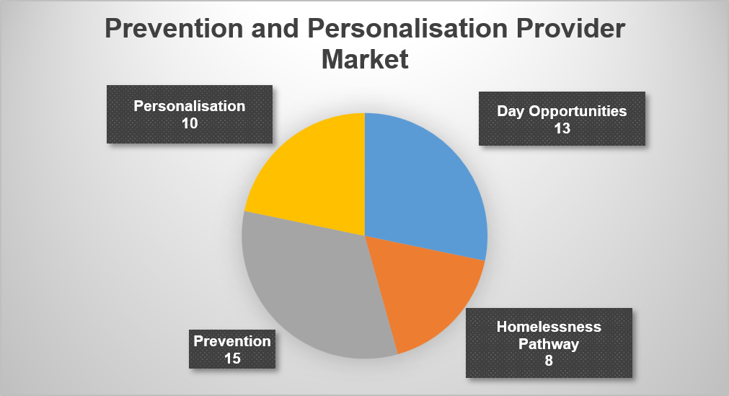
Within Wakefield, we also work with non-CQC regulated care providers, to deliver support outside of the ‘personal care’ provision that is regulated by CQC. This could include support such as social inclusion, community engagement and information and advice on social care related subjects. These providers, such as the VCSE, of which contribute an overall majority to our prevention services, day opportunities and ISF manager providers, support delivery of our duty to prevent, reduce and delay the need for care and support for people across Wakefield. Our non-CQC regulated commissioned market is as follows:


In addition to the externally commissioned services, Wakefield Council offers care services, directly managed by Council staff. This offer includes two residential homes on both the western and eastern sides of the district, two extra care facilities, jointly with the on-site housing providers, also on the eastern and southern parts of the district. Bed and Home based Reablement services are offered across the whole district through a Recovery Hub in the West and two home care hubs located in the east and west Wakefield. In addition to these, Wakefield also delivers supported living and shared lives provision, which is spread across the district. All services delivered by Wakefield are rated good or outstanding by the Care Quality Commission (CQC).

Whilst in-house services are not directly commissioned, they form part of the market shaping activity, alongside the external market. Reviewing the market as a whole, both internal and external provision, helps to achieve our goals in ensuring there are no gaps in the offer of care and support across the district.

In addition to the CQC registered care services, there are frontline services that provide an in-house offer in relation to prevention, under our Care Act duties, these are:

  • Technology Enabled Care – technology-first approaches to reduce risk and support independence
  • Optimised Handling – early triage and right-first-time support
  • Equipment – aids to daily living and support for discharge
  • Adaptations – housing solutions to enable safe living at home
  • Wheelchairs (Health funded) – mobility support to maintain independence
  • Sensory Services – rehabilitation to reduce isolation and promote wellbeing
  • Day Opportunities – 10 bases across the district  providing daytime activities and social inclusion for people
     
    Through meeting our prevention duties these services:
  • Prevent escalation and hospital admission
  • Support hospital discharge and the Home First approach
  • Reduce reliance on long-term and residential care
  • Improve outcomes and system sustainability
Last updated: 21/08/2026